Agent Engineering Playbook

- Published on

Agent Engineering Playbook
Most writing about coding agents still lives at one of two extremes. It is either beginner material that stops at "install the CLI and ask for help", or it is frontier material written by people who are already juggling a swarm of terminals and speaking in private jargon. That leaves a gap right where most serious builders actually live: past the novelty, but not yet running an agent factory.
This series is meant to close that gap.
It is about using Claude Code as an actual working system, not as a demo. It covers how to shape its memory, when to turn repeated prompts into skills, why MCP is more useful than the old "plugin" mental model, how subagents change the way you break down work, and what orchestration starts to look like once one agent is not enough. It also moves into two more ambitious ideas: Recursive Language Models as a way to fight long-context decay, and Steve Yegge's Gas Town as a concrete example of what a multi-agent operating model looks like when somebody pushes it all the way into the deep end.
The reading order matters. The early chapters are practical. The later ones get more architectural.
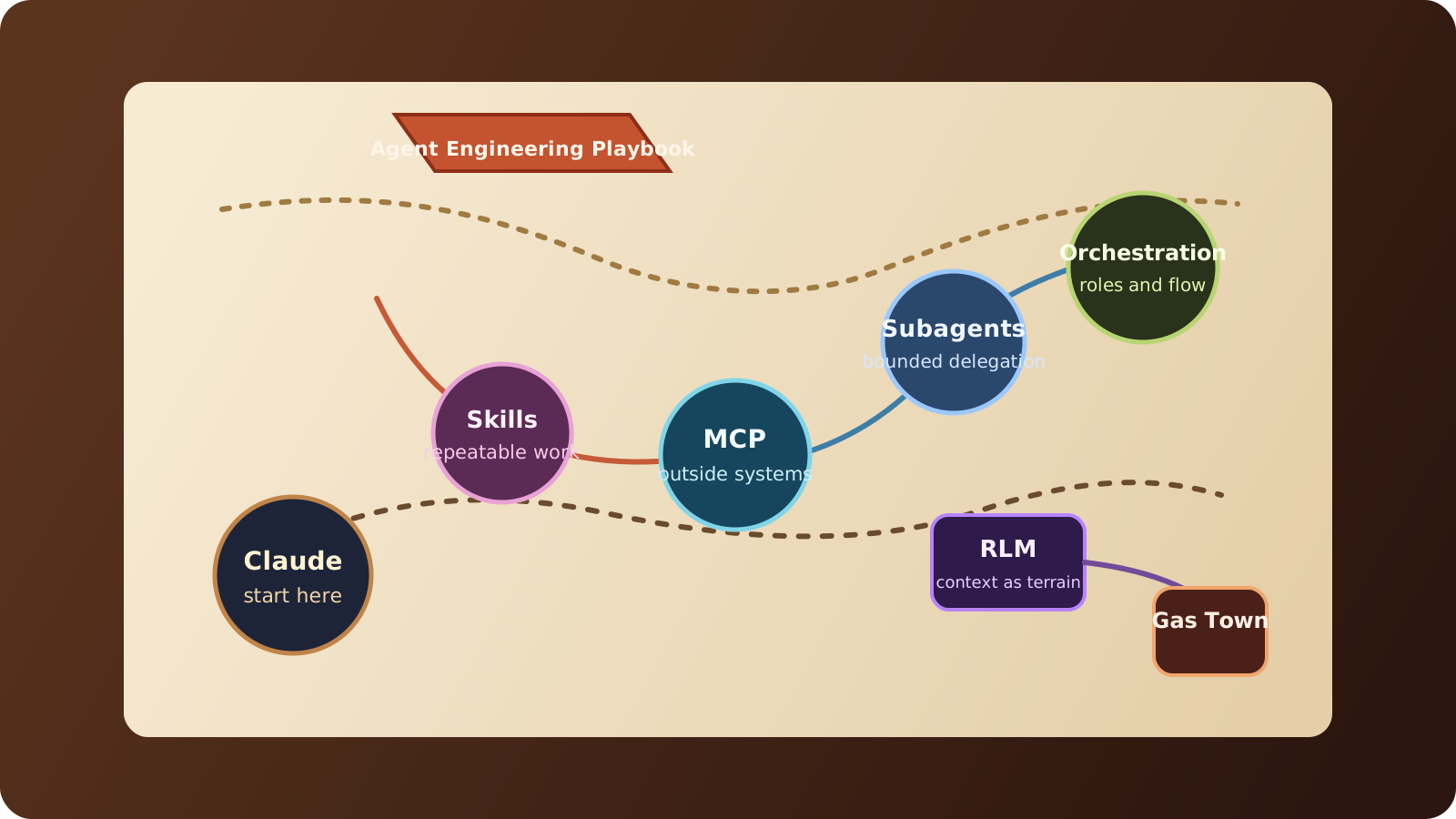
A Practical Start With Claude Code
The working mental model, the first setup that matters, and the habits that make Claude Code useful instead of noisy.Skills, Hooks, and Plugins in Claude Code
How to turn one-off prompting into reusable capability withSKILL.md, supporting files, hook automation, and sharable packaging.MCP From First Principles
What the Model Context Protocol actually is, how hosts, clients, and servers fit together, and how to connect Claude Code to external systems without losing control.When to Use Subagents, and When Not To
How to split work across isolated contexts, how to keep delegation from turning into chaos, and what makes a good specialist agent.Orchestration Patterns for Real Agent Work
The practical layer above single-agent usage: planners, executors, reviewers, queues, approval gates, mailboxes, and merge discipline.RLMs, Context Rot, and Recursive Orchestrators
Why very long context eventually decays, what Recursive Language Models are trying to fix, and how that idea changes the design of agent systems.What Gas Town Is Really Building
A close reading of Steve Yegge's Gas Town: what is novel, what is operationally useful, and what you should borrow before you try to copy it.
I wrote the series against primary sources wherever the tooling is still moving: the Claude Code docs, Anthropic's pages for memory, skills, hooks, subagents, and MCP integration, the MCP specification, Alex Zhang's Recursive Language Models write-up and official repository, plus Steve Yegge's Welcome to Gas Town and the Gas Town repository.
If you only read one chapter, read the Claude Code piece first. If you are already working with three or more agent loops, skip to orchestration and Gas Town. If your real problem is enormous context, jump to the RLM chapter. The whole point of the playbook is not to make you adopt every layer. It is to help you choose the right one before you build the wrong thing.