Orchestration Patterns for Real Agent Work

- Published on

Orchestration Patterns for Real Agent Work
Part of the Agent Engineering Playbook.
Once one agent is not enough, the next mistake is assuming the answer is "more agents."
It usually is not.
The hard part is not spawning workers. The hard part is deciding who owns framing, who owns execution, how state survives between steps, how conflicts get resolved, and when the whole system is allowed to stop. That is orchestration.
If prompting is about telling a model what to do, orchestration is about deciding how work moves.
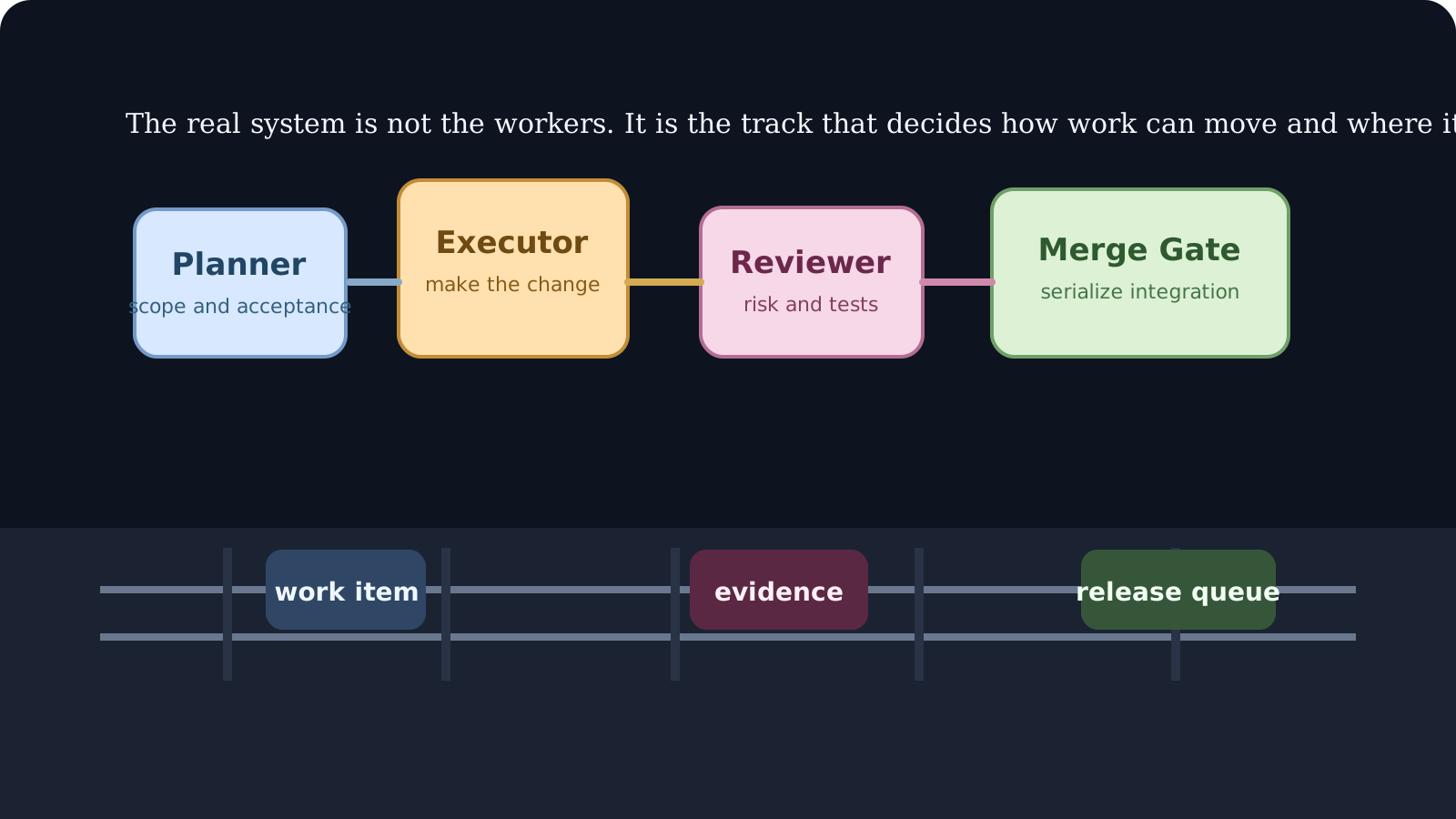
Orchestration Is Mostly About Boundaries
The teams that struggle with multi-agent systems are often not missing better models. They are missing explicit roles.
Someone has to plan. Someone has to execute. Someone has to verify. Someone has to decide whether the result is good enough to merge or whether it has to cycle again. Sometimes that is one human and one agent. Sometimes it is one lead agent with several subagents. Sometimes it becomes a whole framework. But the jobs do not go away just because the system is AI-driven.
This is why most reliable orchestration patterns look almost boring when you write them out. They are just classic operational roles with faster workers.
The First Pattern Worth Using: Planner, Executor, Reviewer
If you only adopt one pattern, make it this one.
The planner turns the request into a bounded change with clear acceptance criteria. The executor makes the change. The reviewer checks correctness, risk, and missing tests. If necessary, the work loops back.
This sounds simple because it is. It is also where a lot of agent systems suddenly become more trustworthy. You stop asking one model instance to do everything in one emotional breath. You create friction in the one place friction helps: before a bad change becomes a merged change.
The trick is not to overcomplicate the roles.
The planner should not silently implement. The executor should not redefine scope. The reviewer should not become a vague "thought partner." Each role needs a clear product. That is what makes the loop observable.
The Pattern After That: Research, Implement, Verify
This pattern is useful when the work is uncertain rather than merely large.
The first step gathers facts, file references, and likely risk areas. The second step makes the smallest credible change. The third step runs the relevant checks and asks whether the system now behaves the way the request actually intended.
I like this pattern because it acknowledges a truth many teams ignore: in agent work, research is not overhead. It is a separate failure mode. A bad implementation on top of a bad understanding is often still beautifully formatted.
That is why research and implementation should not be mentally collapsed into one blur.
The Pattern Most Teams Need But Rarely Name: Merge Discipline
Parallel agent work starts breaking down when everyone edits the same surface area, everyone assumes main has stayed still, or no one owns the integration boundary.
This is where orchestration becomes less about reasoning and more about traffic control.
You need rules for work ownership. You need a limit on how much parallel work can target the same branch or subsystem at once. You need a review or merge queue that can serialize integration when the work starts to collide. If you do not have that, your swarm becomes a rebase machine.
This is one reason I think a lot of "agent factory" demos are less useful than they look. They show task fan-out but not integration cost. In real engineering systems, integration is half the story.
The State Problem
Every orchestration system has to answer a very plain question: where does work live when an agent is not actively thinking?
If the answer is "inside the session," the system is fragile. Sessions end. Context gets compacted. threads drift. Workers crash.
Reliable orchestration wants externalized state. That can be tickets, files, ledgers, issue trackers, or workflow graphs. The exact storage choice matters less than the principle: work should exist outside the transient mind of the current agent invocation.
This is one of the key reasons more serious orchestrators start inventing mailboxes, work items, ledgers, or queue objects. They are not being clever. They are escaping session amnesia.
Human Approval Still Matters
One of the more confused ideas in agent tooling is that orchestration is about removing the human. In good systems, it is usually about moving the human to the right checkpoints.
Humans should not have to micromanage file discovery or routine implementation steps. But humans are still the right place for scope changes, risky tool use, deploy approval, and final judgment on ambiguous outputs.
That is not a weakness in the system. It is the point where responsibility stays attached to the part of the workflow that can actually carry it.
What Reliable Orchestration Feels Like
When a system is working, the flow becomes legible.
You can see what request started the work. You can see which role owns the current step. You can see what evidence came back. You can see whether verification passed. You can see where the work item lives if the system pauses and resumes later.
When a system is not working, all of those things are blurry. The agents are busy. The logs are long. The result is uncertain.
The benchmark is not how impressive the orchestrator sounds. The benchmark is whether another engineer can tell what happened without reading five thousand lines of chat history.
Before You Build a Framework
Most teams do not need a grand orchestrator first. They need a few disciplined patterns, stored prompts, shared memory, one or two subagents, and a verification loop that is hard to skip.
That stack already gets you surprisingly far.
If your real bottleneck is no longer workflow discipline but massive context itself, continue with RLMs, Context Rot, and Recursive Orchestrators. That is a different class of problem, and it deserves a different kind of solution.