Composable AI Architecture

- Published on
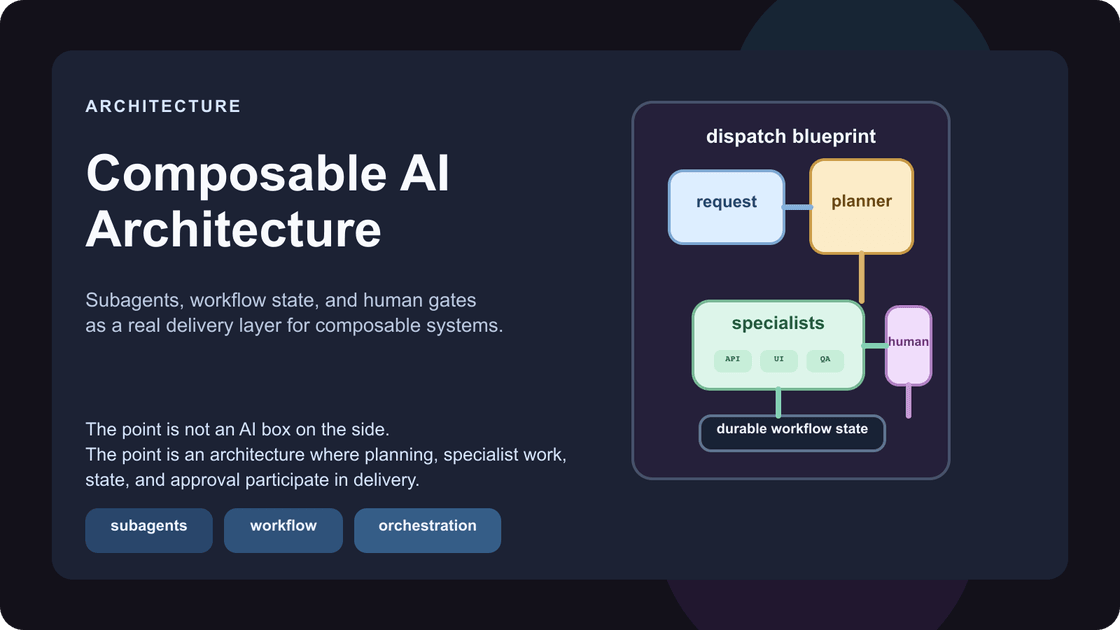
AI becomes useful when it behaves like architecture, not magic.
Most teams add AI the same way they add a demo feature: a prompt box here, a helper endpoint there, a thin layer of automation wrapped around one brittle workflow. It looks impressive in a walkthrough, but it does not survive contact with real delivery. The moment the system has to coordinate multiple tasks, respect real ownership boundaries, preserve state across time, and produce changes that can actually ship, the “just call the model” pattern starts collapsing.
That is where composable architecture becomes useful again.
The same instincts that make a frontend durable also make AI delivery durable. Clear contracts matter. Execution boundaries matter. Workflow state needs a home. Human approval belongs in the system, not outside it as an apology after the fact. If your product already benefits from a composable architecture, AI should not be treated as a foreign body. It should plug into that architecture as another execution and orchestration capability.
AI Should Arrive as Capability, Not as a Widget
When AI is bolted on late, it usually lands in the wrong place.
Sometimes it gets trapped in the UI as a chat surface pretending to be product strategy. Sometimes it gets buried in a backend service that now owns planning, content generation, business heuristics, and workflow state all at once. Sometimes it becomes a sidecar script that quietly edits code or data without participating in the normal delivery system.
All three approaches have the same problem: the AI capability is there, but it is not composable.
You cannot swap pieces cleanly. You cannot route work to the right specialist. You cannot inspect what state the system used to make a decision. You cannot tell where planning ends and execution begins. The result is not just technical mess. It is operational ambiguity.
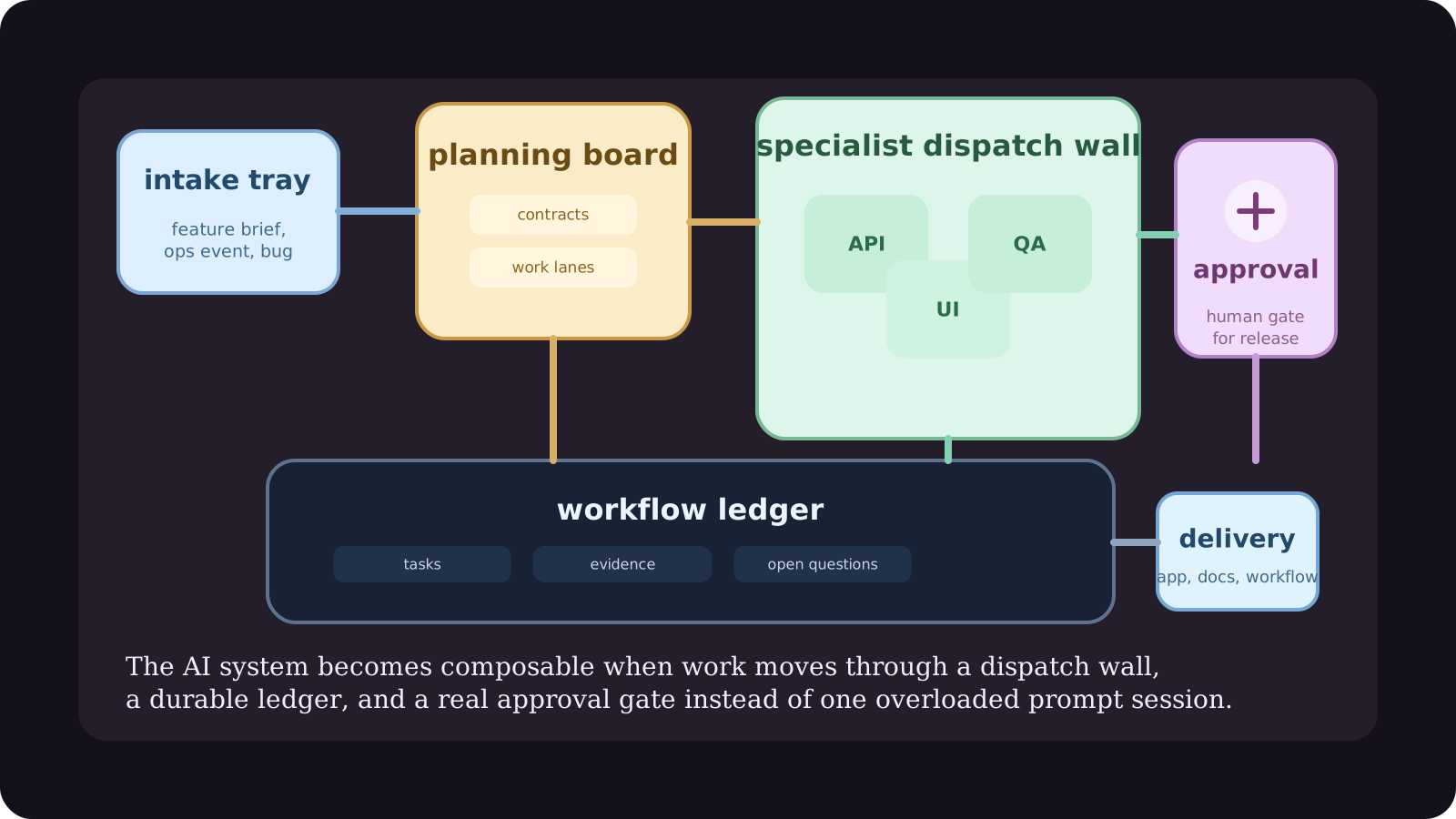
Composable AI starts from a stricter idea. The model is not the system. It is one worker inside the system.
That sounds simple, but it changes everything.
What Composable AI Actually Means
In practice, composable AI means treating AI work as a set of bounded responsibilities that can be combined, inspected, replaced, and governed.
A planner agent should be able to turn a request into a bounded work graph without also being the same thing that edits every file. A reviewer agent should evaluate results against evidence, not silently redefine the task. A retrieval step should have a stable contract. Workflow state should live outside the transient memory of the current model invocation. Approval should be a first-class stage, not a comment in the runbook.
That is the same basic logic behind composable frontend architecture.
In Composable Frontend Architecture, the system becomes healthier when runtime, execution, interaction, and presentation stop competing for the same layer. AI systems behave the same way. They get more useful when planning, execution, memory, verification, and routing stop pretending to be one indivisible “assistant.”
Where AI Fits in the Composable Model
The easiest mistake is to assume AI replaces the architecture. A better way to think about it is that AI extends the architecture.
Composable Execution Layer (CEL) still matters because tools, side effects, business actions, and service access need stable contracts. The model should call into those contracts, not invent alternate pathways around them.
Cross-Surface Execution Engine (CSEE) matters because AI-assisted work may run in different places. Some tasks belong in a browser session. Some belong in a secure server job. Some belong in a queued workflow. “Where should this step execute?” is an architectural question, not an implementation detail.
Dynamic Interface Mesh (DIM) and the runtime shell mindset matter because AI often needs composition at the workflow level too. You may assemble a planner, a code specialist, a test runner, and a reviewer into one delivery lane for application work, while another lane assembles a retrieval agent, a policy checker, and an approval stage for content or operations work.
Universal Interaction Framework (UIF) and Modular Interaction Layer (MIL) still matter on the human side. If AI enters the product, the commands, approvals, feedback, and accessibility expectations should be shared with the rest of the system. AI interaction should not become a parallel UX universe with weaker rules.
The point is not to create an “AI layer” as a fashionable rectangle on a slide. The point is to let AI participate in the architecture the same way any serious capability has to.
A Practical Example: Composable Subagents Building an Application
Imagine a team wants to add a new subscription management feature.
In a weak AI setup, someone asks one large model session to “build the feature.” The session researches requirements, proposes a schema, edits backend code, edits frontend code, writes tests, and maybe drafts release notes. It feels fast right up to the moment you try to understand what happened, verify the result, or resume the work after context has drifted.
In a composable AI setup, the request is decomposed.
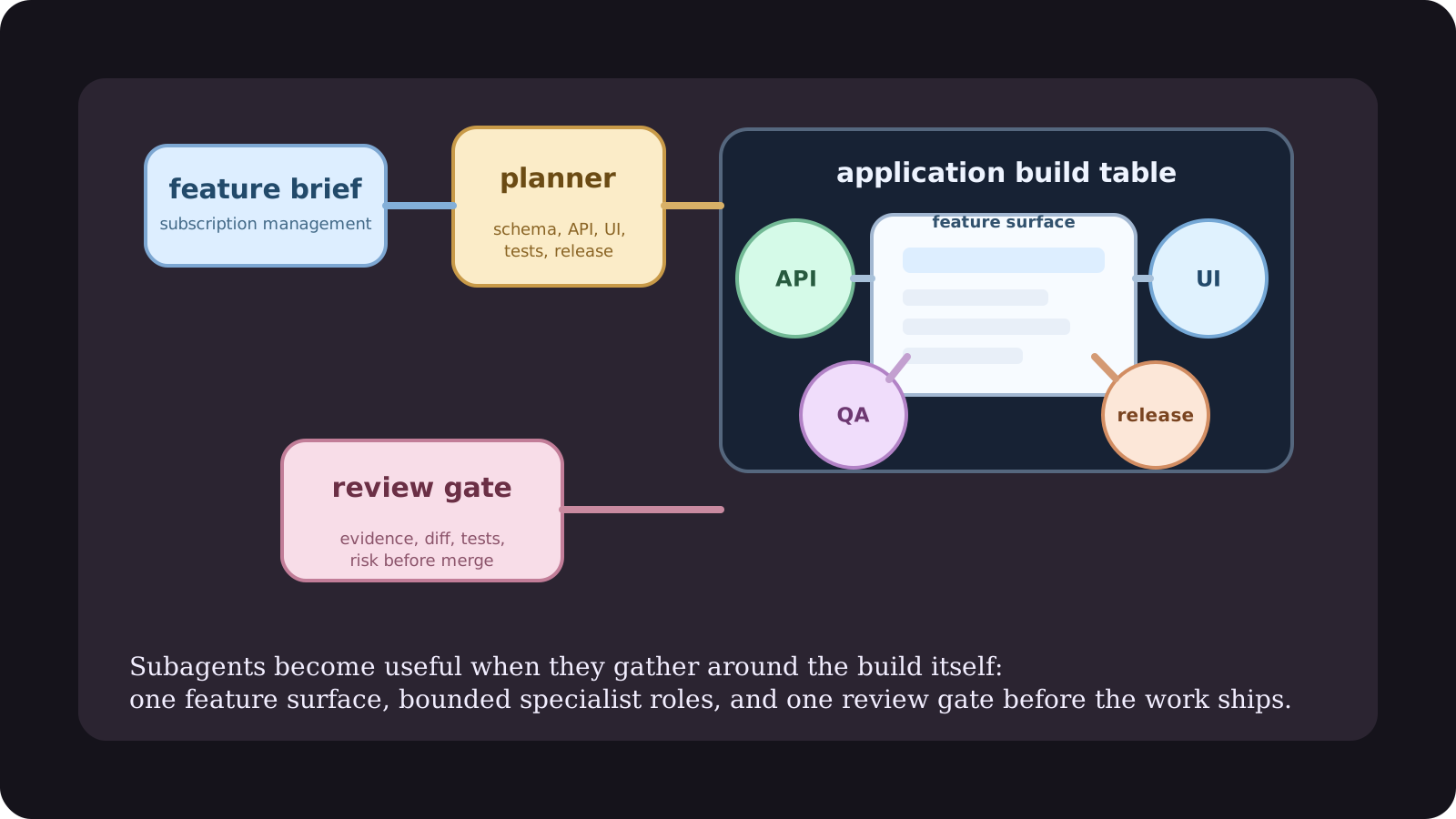
The planner turns the feature request into a real work graph: schema changes, API work, frontend screens, billing integration, test coverage, documentation, and release gates. Those tasks become explicit artifacts. Then specialist subagents take bounded slices:
- one agent owns the domain model and API contract
- one agent owns the frontend flow and interaction states
- one agent verifies tests and regression risk
- one agent checks rollout concerns, telemetry, and release notes
None of those agents needs to remember the entire project alone. Each one works against a bounded contract and a known output. The orchestrator is responsible for routing work, preserving state, and deciding what evidence has to come back before the next stage can start.
That is what “composable subagents” should mean. Not a swarm for its own sake. A system where specialist workers can be assembled into a reliable delivery path.
Automated Workflows Need Durable State
This is the part many AI systems still get wrong.
A long-running workflow cannot live only inside chat history. If the current session is the only place where task status, retrieved facts, approvals, and pending questions exist, you have not built a workflow. You have built a fragile thought bubble.
Composable AI needs externalized state.
That can be a work ledger, queue, ticket graph, build artifact store, or orchestration database. The storage choice is less important than the principle: if the planner finishes and the executor starts tomorrow, the system should not need to reconstruct reality from memory fragments.
This is why the best agent systems start looking more like workflow systems than chat products. They need durable tasks, resumable steps, visible outputs, and explicit gates. The model is an executor inside that loop. It is not the loop itself.
Human Approval Is Part of the Design
Teams often talk about human-in-the-loop as though it were a concession. It is not. It is one of the cleanest composable boundaries in the system.
Human approval is where scope changes, risky operations, ambiguous tradeoffs, and release ownership belong. The system should know when it must stop and surface evidence. That is better than pretending full autonomy exists while quietly pushing responsibility back onto whoever notices the problem first.
In application delivery, this matters even more. A subagent can propose a migration. It should not silently decide whether production is ready for it. A reviewer can summarize test evidence. A human owner should still decide whether the risk profile is acceptable. Good architecture keeps that boundary explicit instead of burying it in optimism.
Why This Matters Beyond Coding Agents
The application-building example is useful because it is concrete, but the pattern is broader than code generation.
The same composable AI approach works for internal operations, customer support escalation, content workflows, experimentation pipelines, and design-system maintenance. In each case, the winning move is the same: break the work into stable contracts, assign bounded specialists, preserve state outside the current model, and route the workflow through real checkpoints.
Once you see that pattern clearly, AI stops looking like one magical interface and starts looking like infrastructure.
That is the real addition to composable architecture. AI is not just another feature delivered by the architecture. It can become a delivery capability inside the architecture.
Where Teams Usually Go Wrong
The first failure mode is prompt soup. Too much logic lives in one hidden prompt, so nobody can reason about the behavior or change it safely.
The second is fake specialization. Teams create many agents, but none of them has a real contract or ownership boundary, so the swarm is just chaos with labels.
The third is missing state. Work cannot resume cleanly because the real workflow only exists inside conversation history.
The fourth is skipping governance. Agents can touch code, data, or live systems without the same review and approval discipline the rest of the platform already requires.
The fix in every case is architectural discipline, not a more breathless prompt.
Composable AI Is a Delivery Pattern
I think this is the more useful way to frame it.
Composable AI is not a prediction about consciousness or a branding exercise for “agentic” systems. It is a delivery pattern for teams that already know systems become healthier when responsibilities are explicit and boundaries are real.
If you already believe in composable frontend architecture, then AI should feel less like a discontinuity and more like the next system asking for the same architectural maturity. Give it contracts. Give it orchestration. Give it durable state. Give it human gates. Then let specialist subagents participate in the work the same way any serious part of the platform has to.
That is how AI stops being a side experiment and starts becoming part of how the architecture delivers.