The Future of Work

- Published on
The Future of Work
Why I Had to Change
I was sitting in my home office on a Tuesday morning, staring at yet another requirement document for a web application I was supposed to build. The project was interesting enough, but as I read through the specifications, I felt a growing sense of unease. I'd been building similar systems for over a decade, and while I'd gotten good at it, I couldn't shake the feeling that the world was moving in a direction I wasn't prepared for.
Everywhere I looked, I was reading about artificial intelligence. Not just in tech blogs, but in business publications, in industry reports, in conversations with colleagues. AI wasn't coming—it was here, and it was changing everything about how we build software, how we solve problems, and ultimately, how we work.
The realization hit me hard: if I didn't adapt, I would become obsolete. Not tomorrow, maybe not next year, but eventually. The skills that had served me well for so long wouldn't be enough in a world where AI could write code, design systems, and make decisions. I had a choice to make: either double down on what I knew, or take the leap into something new and uncertain.
That choice led me to where I am today, on a journey toward becoming an AI architect. And along the way, I've learned a lot about what the future of work really looks like—not just for me, but for all of us.
The Changes I'm Seeing
The transformation happening in workplaces today feels different from previous technological shifts. When the internet became mainstream, it changed how we accessed information and communicated. When mobile phones took over, it changed how we interacted with technology. But AI feels different—it's changing how we think, how we create, how we make decisions.
In my own work, I've seen this firsthand. Tasks that used to take me days now take hours with AI assistance. Code that I would have written from scratch can now be generated with a few well-crafted prompts. Debugging that used to involve tedious trial and error can now be accelerated by AI tools that understand the context of what I'm trying to achieve.
But it's not just about efficiency. AI is enabling entirely new ways of working. I can now analyze massive datasets to uncover insights that would have been impossible to find manually. I can build prototypes and test ideas in minutes instead of weeks. I can focus on the creative and strategic aspects of my work while AI handles the repetitive and mechanical parts.
What's fascinating is how this is changing the nature of expertise. The most valuable skill isn't knowing how to do everything anymore—it's knowing how to ask the right questions, how to evaluate AI outputs critically, and how to integrate AI capabilities into human workflows effectively.
What I've Discovered About Time and Delivery
Through my work with AI systems, I've made a discovery that has fundamentally changed how I think about software development: the biggest and most time-consuming part of the SDLC process has always been coding. Not just the act of writing code, but the entire ecosystem around it—debugging, testing, refactoring, documenting, and maintaining codebases.
AI's biggest contribution so far hasn't been eliminating coding entirely, but making it dramatically easier. What used to take me days of trial and error, of looking up documentation, of wrestling with syntax and APIs, can now be accomplished in hours with AI assistance. The AI tools I use don't just write code—they explain concepts, suggest improvements, catch bugs before they happen, and help me think through problems more systematically.
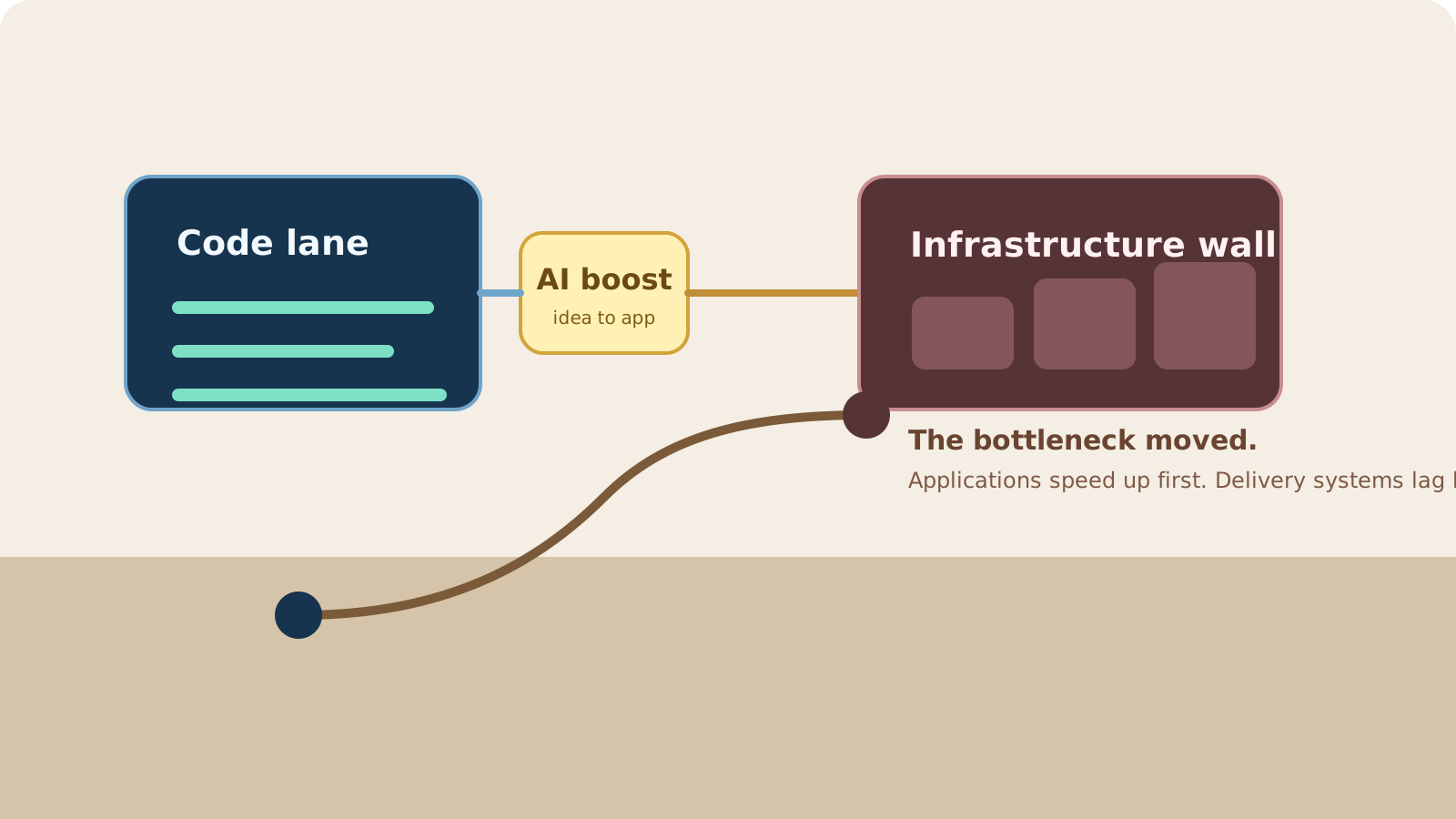
This acceleration has been incredible, but it's also revealed a new bottleneck that I wasn't expecting. As coding becomes faster, I'm running into a wall that has nothing to do with my ability to write software: the infrastructure that supports our applications.
Here's what I'm seeing in my own projects: I can generate and prototype application code at a speed that would have been unimaginable a few years ago. But when it comes to deploying that code, setting up the necessary infrastructure, configuring the cloud services, and making everything work together—I'm hitting the same delays I always faced. In some ways, it's even more frustrating now because the contrast is so stark. I can build the application in a day, but getting it properly deployed and scaled might take weeks.
The cloud infrastructure we've built was designed to be robust, reliable, and secure—and it excels at those things. But it wasn't designed for the kind of rapid application development and deployment that AI is now enabling. We have infrastructure patterns that assume a certain pace of development, a certain number of applications, a certain level of human oversight. AI is breaking all those assumptions.
This is becoming the new wall in software delivery, and I believe it's where AI needs to focus next. We need AI systems that can help us design and deploy infrastructure as quickly as we can now develop applications. We need intelligent automation that can understand application requirements and generate the necessary cloud configurations, networking setups, security policies, and monitoring systems.
The challenge is that infrastructure is different from application code. It involves more constraints, more dependencies, more potential for catastrophic failures if something goes wrong. But that's exactly why AI could be so valuable here—it can help us navigate the complexity, ensure we're following best practices, and catch potential issues before they become problems.
In my own work, I'm already experimenting with AI tools that help with infrastructure as code, that can analyze cloud architectures and suggest optimizations, that can help troubleshoot deployment issues. The results are promising, but we're still in the early stages.
What I've learned is that the future of software development isn't just about AI helping us write better code—it's about AI helping us bridge the gap between idea and production. The real productivity gains will come when AI can help us move as fast on infrastructure and operations as we can now move on development.
The Skills That Matter Now
As I've been navigating this transition, I've had to completely rethink what skills are valuable. The technical skills I spent years mastering—specific programming languages, framework knowledge, system design patterns—are still important, but they're not enough anymore.
The skills that are becoming increasingly valuable are different. They're about understanding how to work with AI systems, how to prompt effectively, how to validate AI outputs, and how to design systems that combine human and artificial intelligence. These are skills that didn't even exist a few years ago, and they're becoming essential for anyone who wants to stay relevant in technology.
But it's not just technical skills. The human skills—creativity, critical thinking, emotional intelligence, communication—are becoming more valuable, not less. As AI handles more of the routine work, the uniquely human capabilities become the differentiators. The ability to understand context, to navigate ambiguity, to build relationships, to lead teams—these are the skills that AI can't replicate.
I've had to invest heavily in learning these new skills. I've spent countless hours practicing prompt engineering, learning about different AI models, understanding their limitations and biases. I've had to become more intentional about developing my creative thinking, about practicing empathy, about becoming a better communicator and leader.
How Work Is Actually Changing
The day-to-day reality of work is already transforming, and I'm seeing this in my own projects and collaborations. Meetings are different now—instead of just discussing what we're going to build, we're talking about how AI can help us build it better. Code reviews include not just human feedback but AI-generated suggestions. Project planning involves considering which tasks are best suited for AI acceleration and which require human judgment.
The nature of collaboration is changing too. I'm working more closely with data scientists, with AI ethicists, with domain experts who understand how to apply AI to specific problems. The boundaries between different roles are becoming more fluid, and the most effective teams are those that can combine technical expertise with business understanding and ethical considerations.
Perhaps most significantly, the relationship between planning and execution is changing. In traditional software development, we would spend weeks or months planning and designing before writing any code. With AI, we can iterate much more quickly—generating multiple approaches, testing ideas, and refining solutions in real-time. This allows for more experimentation and learning, but it also requires a different mindset about planning and decision-making.
The New Career Paths
One of the most interesting aspects of this transformation is the emergence of entirely new career paths. When I started my transition into AI, I thought the main options were to become a machine learning engineer or a data scientist. But I've discovered that the landscape is much richer and more diverse than I initially understood.
There are roles focused on AI ethics and governance—people who ensure that AI systems are developed and deployed responsibly. There are roles in AI product management—people who understand how to translate AI capabilities into products that solve real problems. There are roles in AI education and training—people who help others learn how to work effectively with AI systems.
What's particularly interesting is how traditional roles are evolving rather than disappearing. Software developers are becoming AI-augmented developers. Designers are learning to work with AI tools that can generate and iterate on designs. Business analysts are learning to use AI to analyze data and generate insights.
The common thread across all these roles is the need to understand both the technology and the human context. The most successful professionals in this new landscape are those who can bridge the gap between AI capabilities and human needs, who can translate between technical and business domains, and who can think systematically about how to integrate AI into workflows and organizations.
The Challenges We're Facing
This transition hasn't been easy, and I've faced plenty of challenges along the way. There's the technical challenge of learning entirely new domains and keeping up with a field that moves incredibly quickly. There's the psychological challenge of feeling like a beginner again after years of being experienced in my field. There's the practical challenge of finding the time and energy to learn while still delivering on my current responsibilities.
But there are deeper challenges too. There's the ethical challenge of ensuring that the AI systems we build are fair, transparent, and beneficial to society. There's the organizational challenge of helping companies adapt their processes, cultures, and structures to work effectively with AI. There's the societal challenge of addressing concerns about job displacement, privacy, and the concentration of AI capabilities in the hands of a few large companies.
I've learned that navigating these challenges requires a combination of technical knowledge, ethical reasoning, and practical wisdom. It's not enough to understand how AI systems work—we also need to understand how they affect people, organizations, and society. We need to think not just about what we can build with AI, but about what we should build.
What I've Learned About Adaptation
Through this journey, I've learned that adapting to the future of work isn't just about acquiring new skills—it's about developing a new mindset. The mindset that served me well in my early career—focus on becoming an expert in specific technologies, master established patterns, deliver predictable results—needs to evolve.
The new mindset is about embracing uncertainty, about being comfortable with not knowing things, about being willing to experiment and fail. It's about focusing on learning rather than knowing, about asking good questions rather than having all the answers. It's about seeing change not as a threat but as an opportunity to grow and to create new value.
I've also learned that adaptation is a continuous process, not a one-time event. The skills that are valuable today might not be the skills that are valuable tomorrow. The tools we use today will be replaced by new tools tomorrow. The only constant is change, and the only sustainable advantage is the ability to keep learning and adapting.
This realization has changed how I approach my career and my work. I'm more intentional about learning new things, more open to trying new approaches, more willing to step outside my comfort zone. I've learned to see challenges as opportunities to grow, to view failures as learning experiences, and to maintain curiosity even when things feel overwhelming.
Building the Future Together
As I look ahead, I'm optimistic about the future of work, but not in a naive, technology-will-solve-everything kind of way. I'm optimistic because I believe that AI, when developed and used thoughtfully, can help us solve some of the most important challenges we face. I'm optimistic because I see how AI can augment human creativity and intelligence, allowing us to achieve things that weren't possible before.
But this optimistic future isn't guaranteed. It requires us to be intentional about how we develop and deploy AI systems. It requires us to think about ethics, fairness, and inclusion. It requires us to design systems that augment rather than replace human capabilities. It requires us to invest in education and training to help people adapt to new ways of working.
Most importantly, it requires us to recognize that the future of work isn't something that happens to us—it's something we create together. The choices we make today about how we develop AI, how we integrate it into our organizations, how we support people through this transition—these choices will shape the future for decades to come.
My Advice for Fellow Travelers
If you're reading this and feeling the same urgency I felt a few years ago, if you're wondering how to navigate this transition, I have a few thoughts based on my experience.
Start with curiosity rather than fear. Instead of worrying about AI taking your job, get curious about how AI can help you do your job better. Experiment with AI tools, learn about their capabilities and limitations, and think about how they could apply to your work.
Focus on learning rather than protecting. The instinct to protect your current expertise is natural, but it's counterproductive in a changing world. Instead, focus on learning new skills, even if it means feeling like a beginner again. The willingness to learn is more valuable than any specific skill you currently have.
Build connections rather than going it alone. This transition is too big and too complex to navigate alone. Connect with others who are on similar journeys, share what you're learning, and support each other through the challenges.
Think about value rather than tasks. Instead of focusing on the tasks you currently do, think about the value you create. How can AI help you create more value? How can you combine your unique human capabilities with AI capabilities to solve problems more effectively?
Finally, be patient with yourself and with others. This is a massive transformation, and it's happening faster than any previous technological revolution. There will be setbacks and challenges, but there will also be opportunities and breakthroughs. The key is to keep moving forward, keep learning, and keep believing in your ability to adapt and thrive.
The Journey Ahead
I'm still on this journey, still learning, still adapting, still discovering what it means to work in an AI-augmented world. There are days when I feel confident and capable, and there are days when I feel overwhelmed by how much there is still to learn.
But I'm grateful for the journey. It's made me more resilient, more curious, more humble. It's opened my eyes to new possibilities and new ways of thinking about my work and my career. It's connected me with fascinating people and interesting problems.
The future of work is being written right now, by all of us who are navigating this transition. It's challenging and uncertain, but it's also exciting and full of potential. We're not just adapting to change—we're creating the future of work, one decision, one project, one conversation at a time.
And that, I think, is something to be optimistic about.