Becoming an AI Architect

- Published on

Becoming an AI Architect
The Beginning of My AI Journey
I still remember the moment when I realized that artificial intelligence wasn't just another technology trend—it was fundamentally changing how we build software. I was sitting in a team meeting, discussing yet another complex integration project, when someone mentioned how an AI model could potentially handle the very problem we were struggling with. That comment sparked something in me, a curiosity that would eventually reshape my entire career path.
Like many software developers, I had spent years building traditional systems—web applications, APIs, databases, the usual stack. I was comfortable in this world, confident in my abilities, and I could see a clear path forward in my career. But as AI started becoming more prevalent in our industry, I began to feel a growing sense of urgency. The world was changing, and I needed to change with it if I wanted to remain relevant and continue growing professionally.
The transition wasn't easy. There were moments when I felt overwhelmed by the sheer volume of new concepts, frameworks, and mathematical foundations I needed to learn. But looking back, I realize that this journey has been one of the most rewarding experiences of my professional life. It taught me not just about AI, but about learning itself, about perseverance, and about the kind of architect I wanted to become.
What Does It Mean to Be an AI Architect?
When I first heard the term "AI Architect," I'll admit I wasn't entirely sure what it meant. Was it just a fancy title for someone who knew machine learning? Or was there something more to it?
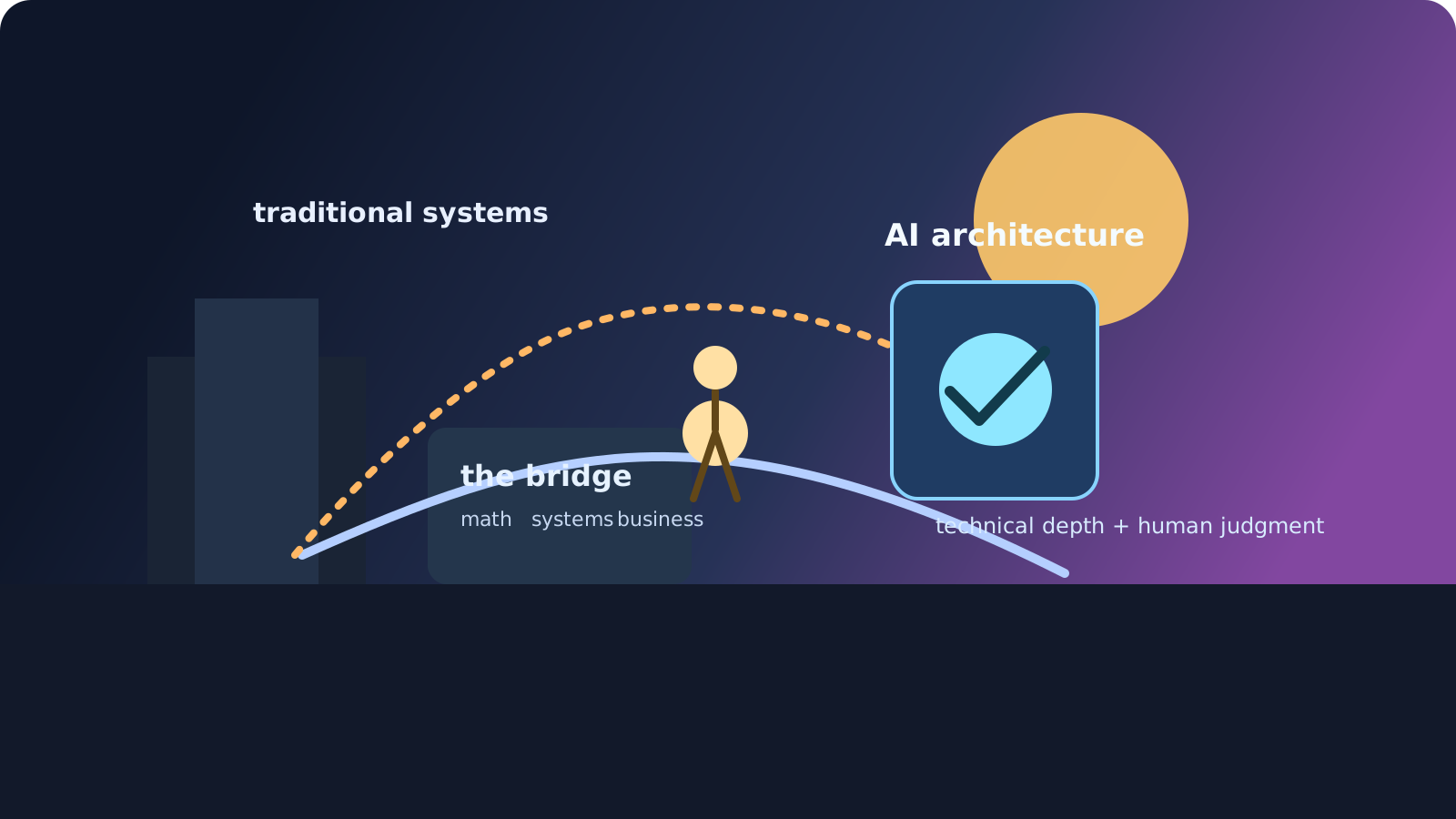
Through my journey, I've come to understand that being an AI Architect is about being a bridge—someone who can connect the possibilities of artificial intelligence with the real-world problems that businesses face. It's not enough to understand how neural networks work or to know the latest deep learning frameworks. An AI Architect needs to understand the entire ecosystem, from data collection and model training to deployment, monitoring, and business impact.
What makes this role different from traditional software architecture is the level of uncertainty and experimentation involved. When you're building a typical web application, you have a pretty good idea of how it will behave. With AI systems, you're dealing with probabilities, with models that might behave differently than expected, with ethical considerations that don't exist in traditional software.
The AI Architect I've become is someone who asks different questions. Instead of just "Can we build this?" I find myself asking "Should we build this?" "What are the ethical implications?" "How will this affect the people who use it?" "How do we ensure it remains fair and unbiased as it learns and evolves?"
The Technical Foundations I Had to Build
My background in traditional software development gave me a solid foundation, but AI required me to build new technical muscles. The first challenge was the mathematical underpinnings—linear algebra, calculus, probability theory. I'll be honest, I struggled with this at first. It had been years since I'd seriously engaged with mathematics, and I felt like I was starting from scratch.
What helped me was connecting the abstract concepts to practical applications. When I could see how matrix multiplication related to image recognition, or how probability theory informed model confidence, everything started to click into place. I spent countless hours working through online courses, reading textbooks, and most importantly, building small projects that forced me to apply these concepts.
The machine learning fundamentals came next. I went from understanding basic regression to implementing neural networks, from traditional algorithms to deep learning architectures. Each concept built upon the last, and gradually, the fog began to lift. I remember the thrill of training my first model that actually worked—nothing fancy, just a simple classification task, but it felt like magic.
But technical knowledge wasn't enough. I quickly realized that AI systems have unique architectural challenges. They need massive amounts of data, specialized computing resources, and sophisticated monitoring systems. The traditional patterns I knew didn't always apply. I had to learn about distributed training, model serving, MLOps pipelines, and the entire ecosystem that surrounds production AI systems.
The Business Side of AI Architecture
One of the biggest surprises in my journey was how much business understanding matters in AI architecture. You can have the most sophisticated model in the world, but if it doesn't solve a real business problem, it's essentially useless.
I learned this lesson the hard way. Early in my AI journey, I got excited about a particular technology and tried to find problems it could solve, rather than starting with the problem and finding the right solution. It was a classic case of solution looking for a problem, and it taught me an invaluable lesson about the importance of business context.
The AI projects that succeeded were the ones where I took the time to understand the business domain deeply, where I worked closely with domain experts, and where I focused on measurable outcomes rather than technical sophistication. This shift in mindset—from technology-first to problem-first—was crucial to my growth as an AI Architect.
I also had to learn to communicate differently with business stakeholders. Traditional software metrics like uptime and response time don't capture the full picture of AI system performance. I needed to learn to talk about model accuracy, bias, fairness, and the business value these systems create. It required me to become a translator of sorts, bridging the technical and business worlds.
The Human Element That Changed Everything
If there's one thing that has defined my journey to becoming an AI Architect, it's the realization that this role is fundamentally about people, not just technology. The most challenging aspects of my work haven't been technical—they've been human.
I've learned that the hardest part of building AI systems isn't training models or writing code—it's understanding how these systems will affect the people who use them. I've spent countless hours in meetings with users, domain experts, and stakeholders, trying to understand their needs, their fears, and their hopes for what AI could help them achieve.
This human focus has changed how I approach every aspect of my work. When I'm designing a system, I think about who will be impacted by it. When I'm evaluating models, I consider not just accuracy but fairness and transparency. When I'm making architectural decisions, I weigh not just technical factors but ethical ones.
The most rewarding moments in my career have come when I've seen the positive impact of AI systems on people's lives—whether it's helping doctors make better decisions, enabling businesses to serve their customers more effectively, or simply making someone's job a little easier and more fulfilling.
The Path That Led Me Here
Looking back at my journey, I can see a few key phases that shaped my development as an AI Architect.
The first phase was about building the technical foundation. I spent months studying machine learning theory, working through courses, and building small projects. There were times when I felt overwhelmed, when I wondered if I would ever grasp the complexities of this field. But persistence paid off, and gradually, the pieces started to come together.
The second phase was about practical application. Theory is one thing, but building real AI systems that work in production is another. I sought out opportunities to work on AI projects, even small ones at first. I learned from failures more than successes, and each project taught me something new about the challenges of deploying AI in real-world environments.
The third phase was about developing architectural thinking. Understanding AI technology is different from knowing how to design systems that use it effectively. I had to learn to think about scalability, reliability, maintainability, and all the other concerns that architects must balance, but in the context of AI's unique characteristics.
The current phase is about leadership and influence. As I've grown in my career, I've found myself increasingly in positions where I need to guide others, make strategic decisions, and help shape how organizations approach AI. This requires a different set of skills—communication, empathy, strategic thinking, and the ability to see the bigger picture.
What I've Learned About the Future
The more I work in AI architecture, the more I realize how much there is still to learn. This field moves incredibly fast, and what's cutting edge today might be obsolete tomorrow. But rather than finding this discouraging, I find it exciting.
I've learned to embrace continuous learning as a way of life. Every week, I try to learn something new—whether it's a new technique, a new framework, or a new way of thinking about problems. I've also learned the value of community, of connecting with other AI professionals who are on similar journeys.
The future of AI architecture is still being written, and I'm grateful to be part of shaping it. I believe we're moving toward more responsible, more ethical, more human-centered AI systems. I believe the role of the AI Architect will become increasingly important as organizations struggle to navigate the complexities of this technology.
Most importantly, I believe that the best AI systems will be those that augment human capabilities rather than replace them, that enhance our creativity rather than diminish it, that help us solve problems that matter rather than optimize for metrics that don't.
Advice for Those Starting This Journey
If you're reading this and considering a similar path, the most useful advice I can give is to treat the transition as a change in operating model, not just a change in tooling.
Start by strengthening the foundations that transfer across hype cycles. That means learning enough statistics, probability, evaluation, and systems thinking that you can reason about model behavior instead of just running examples from a tutorial. Frameworks will change. That underlying judgment stays valuable.
Then build small systems that force you to connect the pieces. Do not stop at a notebook. Take a simple model and turn it into something that has inputs, outputs, failure cases, logging, and a user-facing decision. That is where architecture begins to feel different from experimentation.
It also helps to work backward from real problems. Pick one workflow where latency, prediction quality, explainability, or human review genuinely matters. You will learn faster from a narrow, messy, real constraint than from five polished demo projects that never leave the happy path.
Most importantly, keep your definition of progress honest. The goal is not to sound current. The goal is to become the person in the room who can tell whether an AI system is appropriate, how it should be shaped, and what risks come with it. That takes patience, but it is the part that compounds.
The Journey Continues
Becoming an AI Architect isn't a destination—it's an ongoing journey of learning and growth. I'm still learning, still making mistakes, still discovering new aspects of this fascinating field.
But I've learned enough to know that this is where I'm meant to be. The intersection of technology and human potential, the challenge of building systems that can learn and adapt, the opportunity to make a positive impact—these are the things that drive me every day.
If you're on a similar path, or considering taking the first steps, know that the journey is worth it. The world needs thoughtful, ethical, skilled AI architects who can help shape the future of this technology in ways that benefit everyone.
And who knows? Maybe someday we'll meet at a conference, or collaborate on a project, or mentor the next generation of AI architects together. The future is unwritten, and that's what makes it so exciting.